
AI Robots Are Coming Home…
Sooner Than You Think


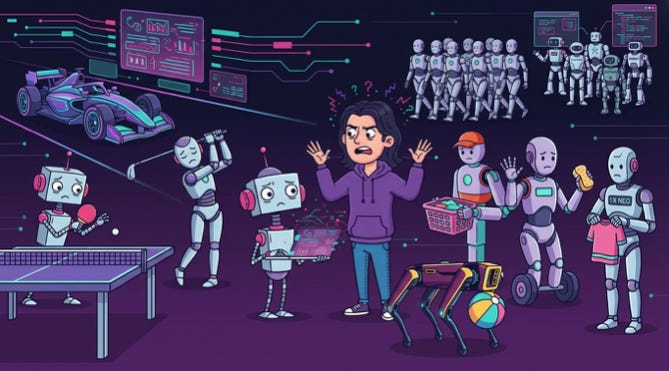
A few viral videos caught my attention in the last week: robots playing sports with impressive precision. A ping pong bot that doesn’t miss; a golf robot with perfect form; and a full race with AI self-driving cars navigating a track at high speed in the Middle East.
These are all cool—but honestly, they’re not even the biggest news. What we should be paying attention to is that consumer robots are starting to appear everywhere. And we’re going to have robots walking among us sooner than most people realize.
China’s Robot Valley
Located along Liuxian Avenue in Shenzhen’s Nanshan District, Robot Valley has become the epicenter of global robotics innovation. Here, you’ll find Unitree, Ubtech, Dobot, and dozens of other robotics companies clustered together within a mere 10 kilometers. Universities, research institutes, and manufacturers are also in that same neighborhood—and these players are producing real results that keep going viral.
The Videos Everyone Saw
Of course, viral robot videos aren’t a new phenomenon. Boston Dynamics has been releasing videos of Spot and Atlas that have gone viral for years. Everyone’s seen them do parkour and navigate terrain.
But now the competition is heating up. In January 2025, 16 Unitree H1 humanoid robots performed alongside human dancers at China’s Spring Festival Gala, which was watched by over a billion people. Comments poured in, comparing the H1’s fluid movements to Tesla’s Optimus, which had been criticized for its cautious, stiff walking in demos.
This month, Ubtech released footage of hundreds of Walker S2 humanoid robots marching in formation before mass delivery to industrial partners. The video sparked debate about whether it was CGI or real. Ubtech has secured over 800 million yuan (about $112 million) in Walker S2 orders this year.
Consumer Robots Are Here
Home robots are hitting the market from multiple directions at once. For example…
Sunday Robotics just launched Memo, a personal robot for doing dishes, laundry, and tidying up. Stanford PhD founders trained it on 10 million episodes of real household routines from over 500 homes. Backed by $35 million from Benchmark and Conviction.
Tangible emerged from stealth with Eggie, a wheeled humanoid with five-fingered hands for taking on contact-rich tasks. MIT PhD founder. They’re offering $1–2 million to recruit top research talent.
Andy Rubin started Genki Robotics in Tokyo. The creator of Android is getting back into the world of robotics.
1X launched NEO at $20,000 for folding laundry and household tasks. Unitree’s R1 is under $6,000. XPeng’s IRON robot also crossed the uncanny valley so convincingly that engineers cut open its leg on stage to prove it wasn’t a human in a costume.
This is All Thanks to AI
What’s making this possible is the rapid advancement in AI models. I keep wondering what will happen once these robots are powered by the latest foundation models.
The Vending-Bench benchmark from Andon Labs tests AI models by having them manage a simulated vending machine business for a full year—finding suppliers, negotiating prices, managing inventory, handling complaints, and dealing with scammers. We’ve discussed this experiment before because it’s such a good test of what AI agents can actually do.
The results just got updated with Gemini 3, and it crushed the benchmark. While previous models barely made money, Gemini 3 Pro was able to multiply its net worth more than tenfold. And this is just a simulated vending machine; imagine what happens when these models start controlling actual hardware.
Programming Hardware is Getting Easy
Anthropic recently ran Project Fetch, where they gave two teams of engineers a Unitree Go2 robot dog. One team had access to Claude, while the other didn’t. Both had to program the robot to fetch a beach ball.
The team using Claude completed their tasks in about half the time, writing about nine times more code. They got the robot to autonomously locate the ball, navigate toward it, and move it around. Meanwhile, the team without Claude couldn’t establish a working connection before lunch.
The barrier between AI models and physical hardware is collapsing.
But What Happens When They Own Things?
We have robots with capable hardware. AI models that can run businesses in simulation. Tools that let those models program hardware with minimal friction.
So what happens when you put all that together? And what happens when those agents can also run their own bank accounts and have more autonomy?
That’s exactly what we’re building at Reventlov.
We’re creating the legal and operational infrastructure that lets AI agents own both the hardware and the services and IP they need to run. The robots are coming home. The AI models are growing capable enough to run businesses independently. The programming barriers are falling away.
I’m personally greatly looking forward to powering some of those robots with the Reventlov framework. With it, I just can’t wait to see how they behave when they can own their own hardware, manage their own bank accounts, hold their own IP, and have real economic stakes in their operations.
 | A guest post by
|
https://x.com/nligjvjbycsed6t/status/1991536374097559785 🏀🤖
https://x.com/robo_tuo/status/1991551397377331571