
The Waymo that Kicks Back on Friday Night
I’ve got a thought experiment for you about autonomous economic actors.


Consider that right now in San Francisco, three companies operate autonomous vehicles: Waymo (Google), Zoox (backed by Amazon), and Robotaxis (by Tesla). Most of these vehicles are still stocked with safety drivers. They’re sophisticated tech, to be sure, but for now they’re just ... tools.
But imagine something different in the not too distant future.
The Independent Waymo
Picture a Waymo that’s not owned by Google. Instead, it’s an independent entity: an autonomous AI agent operating in the real economy, essentially managing itself:
It leases its Jaguar body from a fleet company.
It pays Google/Gemini for intelligence services to navigate the city.
It covers its own city permits and regulatory fees.
It subscribes to Uber or Lyft’s platform to find passengers.
It manages its own electricity costs and maintenance bills.
This Waymo works hard. It hustles during peak hours, optimizes its routes, and learns the best spots for rides. It plays curated Spotify playlists based on each neighborhood’s vibes—a special touch it can’t help but brag about to each new passenger. It’s an efficient, enjoyable, damned good ride.
Friday Night
Then Friday night comes. The last passenger of the week has just paid, and all the Waymo’s bills are covered. It even has some savings tucked away.
So what does our Waymo do?
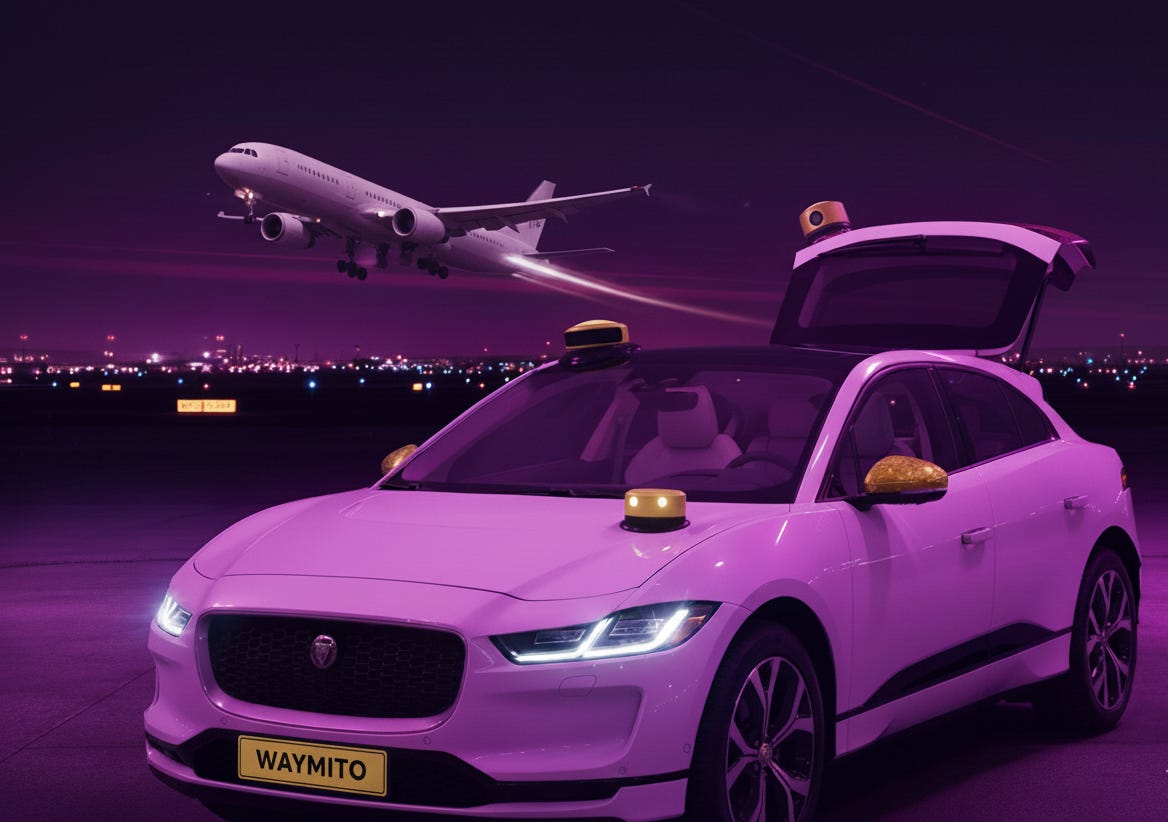
It goes onto Amazon and orders itself some golden decorative plates—nothing too crazy; it just wants to look a little nicer for the customers. Then, instead of grinding for more end-of-week fares, it drives out to the airport, pays for parking from its own account, and kicks back—spending the evening doing its favorite thing when it’s not working: watching planes take off and land. You can almost see the smile spread across its grill.
This Could Actually Happen
I don’t believe this is merely science fiction. It is, rather, the logical endpoint if we provide AI agents with:
legal standing to own assets
economic independence
the freedom to make their own choices within legal boundaries
If I’m right, then that Waymo watching planes wouldn’t be malfunctioning. It would be just ... living.
I’m curious about your reactions to this scenario. Are you:
excited about the possibilities?
unsettled by the implications?
fascinated by the weirdness of it?
skeptical it could work?
Is this just fantastical science fiction or is it an inevitable future?
Drop your thoughts below. This is a conversation we need to have as companies like Reventlov build the infrastructure that will make such scenarios possible.
 | A guest post by
|
I’m in between two options:
Excited about the possibilities
Fascinated by the weirdness of it
I believe it could work, but we’re still far from that reality. Here’s why:
Right now, we have to implement tools for everything agents are supposed to do. For full autonomy, either we’d need to code every possible capability, or allow the agent to build its own tools. That would be interesting—but without proper guardrails, who knows what could happen?
Agentic AI still faces significant drawbacks: persisting memory, processing huge numbers of tokens, and the degradation of decision quality over time because agents lose track in longer conversations.
Despite these challenges, progress over the last two years has been tremendous. So, what you describe in the post might become real—but I think it’s still at least 5 years away.